07 July 2006

Quote for the Day

"To live within a just order is to live within a pattern that has beauty. The individual finds purpose within an order, and security - whether it is the order of the soul or the order of the community. Without order, indeed the life of man is poor, nasty, brutish, and short."

Russell Kirk (1918-1994)

06 July 2006

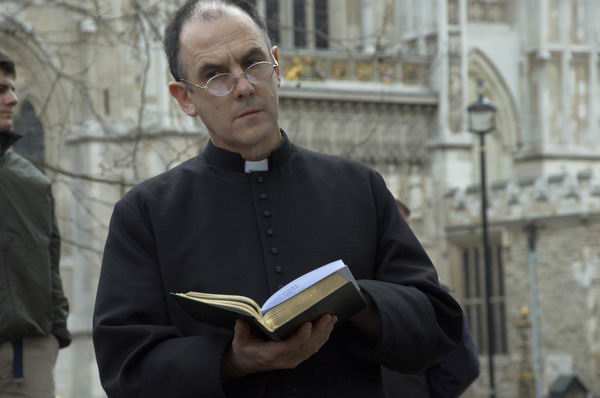
Spucatum tauri: The Rev. Philip Chester

Anglican Rev. Philip Chester, vicar of St. Matthew's in Westminster, UK, has a modest proposal. He wants to change England's patron saint from St. George to St. Alban. The purported reason? Lack of clear evidence St. George existed. Umm, right. The real reason? St. George is associated with the Crusades and this could offend Muslims.

"We are sure St Alban is a real figure," barked Chester. Well, in that case go right ahead. What defense could we possibly muster against such compelling logic?

St. Alban was martyred in England in the early 4th century. He is a martyr because he refused to compromise his faith in the face of adversity. Apparently his faith offended someone. In dumping St. George because his presence might offend Musilms, Rev. Chester is proposing the Anglican Church do precisely what St. Alban died to avoid. How ironic, and sad.

05 July 2006

Quote for the Day, part 2

This post is dedicated to the man who sent me this same poem a while back, when I was facing the same difficulty he's facing now. Just remember, dear friend, it is in fire that gold is tested.


Solitude
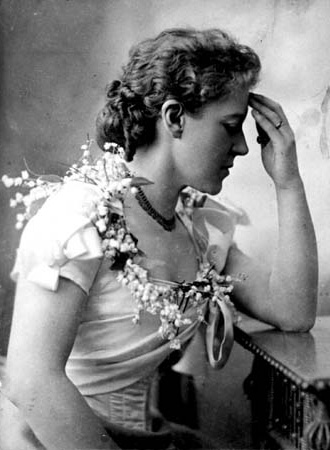
By Ella Wheeler Wilcox

Laugh, and the world laughs with you;
Weep, and you weep alone;
For the sad old earth must borrow its mirth,
But has trouble enough of its own.
Sing, and the hills will answer;
Sigh, it is lost on the air;
The echoes bound to a joyful sound,
But shrink from voicing care.

Rejoice, and men will seek you;
Grieve, and they turn and go;
They want full measure of all your pleasure,
But they do not need your woe.
Be glad, and your friends are many;
Be sad, and you lose them all,—
There are none to decline your nectared wine,
But alone you must drink life’s gall.

Feast, and your halls are crowded;
Fast, and the world goes by.
Succeed and give, and it helps you live,
But no man can help you die.
There is room in the halls of pleasure
For a large and lordly train,
But one by one we must all file on
Through the narrow aisles of pain.

Quote for the Day


If you have it [love],
you don't need to have anything else.
If you don't have it,
it doesn't matter much what else you do have.

- Sir James Matthew Barrie, author of Peter Pan -

02 July 2006

Chronicle of the Damned, part 12


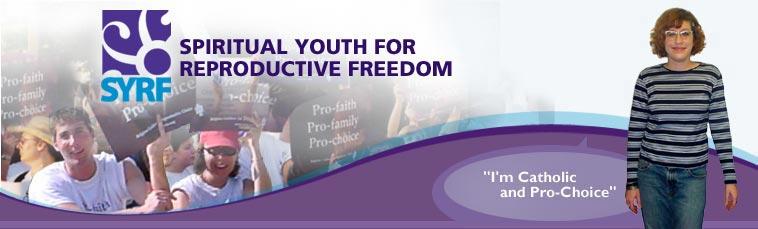
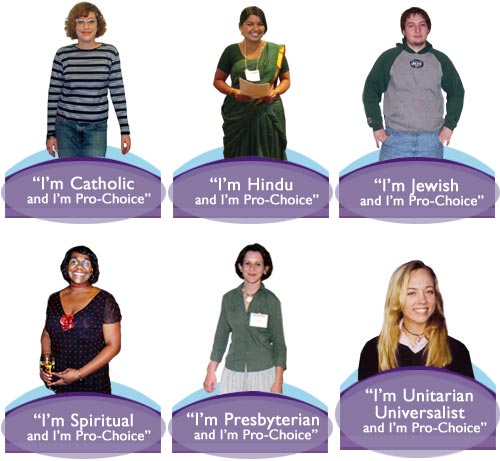
My first reaction when stumbling upon this website was to wonder why the girl at the right side of their logo (see above) would ever need to worry about reproductive freedom. My hunch is that the barriers between her and the copulatory act (with a man, anyway) are many. But I digress.

"Spiritual Youth for Reproductive Freedom (SYRF) educates, organizes and empowers youth and young adults (ages 16-30) to put their faith into action and advocate for pro-choice social justice."
Ok, I see, it's about 'pro-choice social justice.' And here I was thinking this had something to do with abortion. What a fool I am.

"[SYRF] lifts up pro-faith youth and young adult perspectives on reproductive choice issues and provides young people with tools and opportunities to advocate for choice on their campuses, high schools, congregations and communities."
I'm trying to think back to my Catechism classes and remember my faith's 'perspective' on reproductive choice issues. Ok, now I remember--we can choose to have sex, or not. Seems pretty clear to me, but according to SYRF this line of thought is lacking somehow. I must need more 'tools and opportunities.'

Let's take a look at some testimonials and feedback about the group's sundry activities, posted on SYRF's website (peppered with my comments, of course):

"This experience was awesome, totally inspiring. I don't know if we made a difference today but it made me want to try again tomorrow." (This comment refers to the summit's lobby day on Capitol Hill.)
Well, I have to say that if you feel the need to try again tomorrow, it means you failed today. Thank God for small favors.

"I met other young men and women who think like me, agree with what I have to say, and are struggling just as much."
Wow! Sounds like all the makins' for a great dialogue. Just think how far Socrates could have gone if he only talked to people with whom he agreed.

"I was glad to learn more about pro-choice Christians because where I live it feels like an anomaly. But now I know!"
Newsflash: (and may God forgive your pastor for not telling you this) there's a pretty good reason most Christians aren't pro-choice. Yes, you are an anomaly.

Everyone gets to throw in their $0.02 worth.

Catholics:


"The pro-life position is really a pro-fetus position, and the pro-choice position is really pro-woman. Those who take the pro-fetus position define the woman in relation to the fetus. They assert the rights of the fetus over the right of the woman to be a moral agent or decision maker with respect to her life, health, and family security." (Dr. John M. Swomley)
Thanks for clearing that up, John. Silly me, all these years I've been 'pro-fetus.' Now I see the light.

Jews:

These, then, become the guiding principles on abortion in Jewish tradition: a woman's life, her pain, and her concerns take precedence over those of the fetus; existing life is always sacred and takes precedence over a potential life; and a woman has the personal freedom to apply the principles of her tradition unfettered by the legal imposition of moral standards other than her own. (by Rabbi Raymond A. Zwerin & Rabbi Richard J. Shapiro)
That's great, Raymond & Richard. I didn't know that self-centeredness and moral relativism lay at the heart of Jewish moral thinking. So that's how your faith has survived for thousands of years.

Unitarian Universalists:

Unitarian Universalists have a deep and abiding reverence for life. But we recognize, also, that life is always lived in relationship. Thus, we maintain that moral decisions can never be made in a vacuum but are, instead, always made in the context of competing claims for attention to the quality of life. Women's choices in reproductive matters are morally complex. Such choices can be very difficult, even the occasion for grieving and a profound sense of loss. Nonetheless, the difficulty of such choices does not mean that they cannot also be a faithful and morally affirmative response to what a woman perceives to be holy and just. Women are, inherently, moral agents, as are all people, and they are capable of subtle and sensitive moral discernment. (by Reverend Dr. Rebecca Edmiston-Lange)
Wow Rebecca. That statement is just as vague, mushy, and pointless as Unitarian Universalism itself. Rarely have I seen so many words used to say so little. Have you thought about spearheading the church's evangelization campaign?


One can only wonder at the extent of Satan's joy in capturing these young folks. The depth of his joy will be matched only by the severity of their torment in the afterlife. The minions of Spiritual Youth for Reproductive Freedom will be scattered throughout the Inferno, to caverns far and wide. The most vile among them will dwell in Circle Eight, home of Seducers and peddlers of Fraudulent Rhetoric. The least culpable among them will suffer in Circle Six, home of Heretics.

Their suffering will be profound. So much so, in fact, they will come to wish they had never been born--or, to use their own parlance, that their mothers had made a different reproductive choice.

01 July 2006

Quote for the Day


It's the birthday of editor and writer William Strunk Jr., born in Cincinnati, Ohio (1869). His book The Elements of Style has become the standard style manual for writers all across America. Strunk wrote, "Vigorous writing is concise. A sentence should contain no unnecessary words, a paragraph no unnecessary sentences, for the same reason that a drawing should have no unnecessary lines and a machine no unnecessary parts. This requires not that the writer make all his sentences short, or that he avoid detail and treat his subjects only in outline, but that every word tell."

28 June 2006

Quote for the Day


It's the birthday of Mark Helprin, born this day in 1947. He writes about characters who go on adventures, have crises, and come to appreciate the beauty of life. He said, "I have no agony or resentments. Boredom and alienation don't mean a thing to me."

Editor's note: Postmodernist writers or would be writers, take note and mend your prosaic ways.

Spucatum tauri Bovine excrement: The National Catholic Reporter

Editor's Note: The NCR editorial to which we're referring here is, in the purest sense of the term, spucatum tauri--bullshit. But we know they prefer neutered English, so in deference to their sensitivities we'll call it bovine excrement today. Let it never be said we're overly harsh or unfair.

As if we needed more reasons to doubt the Catholicity of this publication (note the intentional refrain from using "newspaper"), their
6/30/06 editorial on the US Bishops' vote approving liturgical translations more faithful to the original Latin gives us yet another.

The tactics used to reverse the reforms that had resulted from the Second Vatican Council of the 1960s and more than three decades of subsequent work were secretive and engineered by people incompetent in the discipline and accountable only to a small group who had achieved power. That power was used to accomplish what they could not by persuasion or through the mainstream of liturgical scholarship.
Ah yes, more secret Vatican conspiracies. When did Dan Brown join the NCR's editorial board? Their logic seems to be "Church authorities co-opted our agenda and produced an outcome we and our ilk didn't like, so there must have been trouble afoot." And let's not even talk about "mainstream" scholarship. Religious education in parishes and schools is still recovering from the devastation wreaked by "mainstream" scholarship. Do you like emptying pews, an ill-informed flock, and the vocations crisis? Well, you can thank, among other culprits, "mainstream" scholarship for that.

If wars ever have winners, then the winners in this one comprised a small crowd of powerful actors in the Vatican, in league with others passionately opposed to the direction that translation of documents had taken in the 35 years since Vatican II, who managed to overthrow that process and put in place one of their own. In 1997, as John L. Allen Jr. reported nearly eight years ago, 11 men met in secret in the Vatican "to overhaul the American lectionary, the collection of scripture readings authorized for use in the Mass. Short-circuiting a six-year debate over 'inclusive language' by retaining many of the most controversial uses of masculine vocabulary, and revamping texts approved by the U.S. bishops, this group decided how the Bible will sound in the American church."
More conspiracies. It's starting to sound like a John Birch Society leaflet. If we have to thank a conspiracy for killing the utterly absurd move towards "inclusive" language, that's fine by me. By the way, if you say 'he/she/it' fast enough it sounds like 'horseshit', ironically. But I digress. Or do I? How better to describe the attempt to erase a disinction found in both Tradition and Scripture? God chose to reveal himself in the masculine form. Jesus was not a hermaphrodite. Moreover, when Scripture refers to "man" it's in reference to all of mankind. But that's just plain unacceptable to those who would dumb down the language of worship to makeaccommodatedate a political agenda, I guess.

That was the beginning of the final phase of a coup that upended all of the processes that had been in place since Vatican II, translation principles that had been approved by a previous pope and decades of work by a number of bishops and a host of liturgists and Bible scholars.
Yes, the stars aligned and the right-wing cabal prepared to strike its final blow. Like Pinotchet toppling the Allende government, a select few at the Vatican conspired to overthrow the unsuspecting, innocent, and harmless vox populi. Why not just change Pentecost to the closing day of Vatican II?

Of the group that met in secret, only one man (no women were included) held a graduate degree in scripture studies; two members were not native English speakers; another was from the United Kingdom and had spent no significant time in the United States; and the group included several members who came in with reputations for opposing inclusive language. "Powers in Rome handpicked a small group of men who in two weeks undid work that had taken dozens of years," the NCR report continued.
The junta is revealed. What cretins be they, meeting in secret? Too few Americans, not enough native English speakers, no women, and...this is most terrifying, folks, it's not for children or the squeamish...several were known to oppose inclusive language! They cut a swath far and wide, undoing work that had taken dozens of years. What a bunch of malarkey. The NCR is ticked because Rome stopped people from turning us into Episcopalians.

Life goes on and so will the community, even if we have to wrap our tongues around awkward constructions that treat Latin as if it were the language Jesus himself spoke and even if we have to wait longer for our own official language to acknowledge that more than half the human race is female.
Resting on self-congragulatory smugness, the NCR asserts they know better than the corpus of US Bishops (who, by the way, voted 173-29 to accept the more authentic translation...hardly a nail-biter). The revolution failed and the Church is to blame. They speak as if "community" doesn't have anything to do with "communion," forgetting that the latter is requisite for the former. By the way, here's some translation-- "Life goes on...even if we have to wait longer for our own official language to acknowledge that more than half the human race is female," really means: "Life goes on...even if the Church fails to alter Scripture and the liturgy to appease the radical feminist agenda." No need to check that translation, as it's been approved by our own staff of registered curmudgeons.

Finally, we suspect that the way forward will also include accommodating those who simply refuse to go along and will stand in place and continue to use the same language they've been using for decades. Our suspicion is that God will not be terribly upset by a little show of resistance.
I wonder if the NCR shows such magnanimity towards those who came to Mass one day a few decades ago and noticed the priest facing them, the high altar gone, and the Latin absent from the liturgy. Their world changed suddenly, yet they're browbeaten by the "progressives" and told they need to get with the program.

Finally, the NCR's suspicion that God won't mind a little resistance from them is probably true, but only because He's grown accustomed to it by now.

Off the Record, a feature of Catholic World News, also took a humorously satirical shot at NCR's editorial.

27 June 2006

Spucatum tauri: Modern Art


'Thought to Have Merit'
An English sculptor loses his head.

from the Wall Street Journal

BY LIONEL SHRIVER
Tuesday, June 20, 2006
12:01 a.m.

LONDON--Once in a while a news story so speaks for itself that it threatens to put commentators out of a job.

In this year's summer show at London's Royal Academy of Arts, "Exhibit 1201" is a large rectangular tablet of slate with a tiny barbell-shaped bit of boxwood on top. Its creator, David Hensel, must be pleased to have been selected from among some 9,000 applicants for the world's largest open-submission exhibit of contemporary art. Nevertheless, he was bemused to discover that in transit his sculpture had gotten separated from its base. Judging the two components as different submissions, the Royal Academy had rejected his artwork proper--a finely wrought laughing head in jesmonite--and selected the plinth. "It says something about the state of visual arts today," said Mr. Hensel. He didn't say what. He didn't need to.

Moreover, the Royal Academy denies having made an error, for the plinth and hastily carved wooden support were, according to an official statement, "thought to have merit."

For those who despair that artists these days seem to have lost the skill of fashioning meticulously crafted objects, don't blame Mr. Hensel. While the slate base took only four hours to hack from a mortuary slab, and the little boxwood prop less than an hour, he had painstakingly carved and polished that laughing head for two months. But alas, the sculpture itself has--shudder--emotional content. It was originally christened "One Day Closer to Paradise," a far too expressive title; Mr. Hensel would have been better off with the portentously enigmatic "Exhibit 1201." His laughing head is not only fatally well rendered, but exudes a sense of joy and hilarity, and the overtly evocative is declassé. How much more sophisticated, a stoic square of slate that speaks of--well, ask the viewers.

"The sculpture is a mixture of heavy stone with a light piece of wood on top," the Daily Telegraph quoted a Dane as explicating last week while admiring the plinth. "I like the total effect. It is a really nice contrast." A Londoner rejoined, "If it was in more of a minimalist show, it would definitely seem more beautiful." Presumably these folks would find an emperor clad in a "minimalist" manner equally stunning.

Me, I just put a brick on my desk. I gaze in wonderment at the contrast in textures--the smooth, unyielding sides of the brick, the rough, almost sexual crumble on its chipped corner, the humbler, more submissive sensuality of the scarred plywood desktop. I marvel at the fierce, affirmative perpendicular of the brick, in firm opposition to the languid, taciturn serenity of the lateral . . . But that's not even funny, is it? Joseph Beuys has piled bricks on a floor of the Guggenheim and called it art. How exasperating, a field so far out in la-la-land that it is impervious to parody. You see what I mean about being out of a job.

Of course, the Royal Academy's exaltation of that plinth recalls many a misapprehension in galleries, where visitors are wont to coo over the fire hydrants, ventilation grates and trash cans, all of which are more durably and fastidiously crafted than the works on display. For that matter, one gift that contemporary art seems to have given us viewers is a way of seeing every object in our surround--as I look about my study now, the powerful yet precarious piles of paperbacks, the airy, ephemeral flutter of bank statements--as art. But in that event, we not only don't need commentators; we don't need artists, do we?

Or the Royal Academy.

Spucatum tauri: The myth of moral equivalence

Gulags on Ellis Island
A dissonant note of moral equivalence at an exhibit on communist horrors.

BY BRIAN M. CARNEY

ELLIS ISLAND, N.Y.--Tucked out of the way on the top floor of the main building here is a curious little traveling exhibit about the Soviet Gulag. On the day that I visited, no signs in the lobby of the Ellis Island Museum announced the presence of the exhibit; one happened upon it through determination or by chance, stepping with little warning from display cases devoted to the hopes of immigrants seeking freedom or opportunity in America into the hopeless deprivation and cruelty of Siberian death camps.

The Gulag exhibition is on display at the museum through July 4, after which it will travel around the country over the next two years--to Boston; Independence, Calif.; Atlanta; and Washington. The show's title, "GULAG: Soviet Forced Labor Camps and the Struggle for Freedom," offers some hint as to why the exhibit is being housed here during its New York stop; Ellis Island is, in its own way, about the struggle for freedom. And it sits, of course, in the shadow of the Statue of Liberty.

In this setting, the exhibit's collection of artifacts from Gulag camps--supplemented by a brief history, Soviet propaganda newsreels and short biographies of notable dissidents who were exiled to the Gulag at one time or another--takes on an affecting, mesmerizing quality. The space it occupies could be tramped through in the blink of an eye. But one is invited to linger, not least by the secluded feeling up in the attic, away from the bustling main reception hall, and the sense of discovery that comes from having found the exhibit at all. Moreover, the small artifacts with which the story of the Soviet Union's system of forced-labor camps is told are strikingly effective. One display explains that spoons, cups and bowls were in such short supply that the crude and makeshift examples here on display --made from castoff tin cans and bits of scrap metal--were highly prized.

Another explains that the Belomorkanal--a slave-labor-intensive project that was hailed as a great early success of Stalinism--was not only built by terrorized prisoners but proved useless in practice. It is only after this that one is shown the silent newsreels of the allegedly happy socialist workers building the canal, intended to connect the White Sea with the Baltic, while Stalin looks on approvingly. Experienced in this way, the cheerful-seeming newsreel shot takes on a captivating, horrifying double meaning. From the explanatory panels elsewhere in the exhibit, a visitor now knows, watching the grainy footage, that prisoners who grew too weak to move their quota of dirt in this and other projects were routinely killed or left to die; the socialist system had no resources to waste on those who could not contribute their share.

There are also full-scale mockups of a Gulag prison cell and prisoners' firsthand accounts of their degrading treatment at the hands of both guards and fellow prisoners--common criminals were sent to the Gulag along with political dissidents, and the former were often employed by the prison guards as oppressors and tormentors of the latter. As for what constitutes a political crime, we learn of a man sent into exile for scrawling an ironic remark on an allegedly secret ballot (which had, in any case, only one candidate listed). Others, we are told, might receive three years of forced labor for being thrice late to work; indolence was a crime against the people.

But then, abruptly, the spell is broken, and in a dispiriting if not alarming way. "Brutal systems have played a prominent role in many countries, including the United States," one of the exhibit's last panels tells visitors. By itself, that one clause--"including the United States"--would be bad enough. But the panel continues. "Although slavery ended after the American Civil War, its consequences persist. The repercussions of the Holocaust in Europe and apartheid in South Africa reverberate even today. Similarly, Russians face the legacy of the gulag. How can citizens in these countries face up to the horrors of the past?"

Just as it is the small details of the Gulag exhibit that lead one to consider the depth of the deprivation its captives endured, it is the word "similarly" that so effectively undermines what has just been shown. After all, if the Gulag is "similar" to anything in American life or history, does it teach us anything about the Soviet Union--or about anything at all? "If you cannot distinguish between levels of evil, you are a cause of evil." Such was the astute reaction of a man whose father spent a decade in the Gulag, when confronted with this moral equivalence in the paragraph above.

It is certainly true that learning about evils perpetrated in other times in other countries can too easily lead to a comfortable sense of moral superiority. That can, in its own way, undo what might otherwise be a teaching moment. All the same, however, things are not all the same. If the Gulag is interesting only as a means of turning a mirror on the injustices of our own penal system, it is arguably not interesting at all. The Gulag was, and is, a reductio ad absurdum of sorts of the Soviet system itself. It was where "counterrevolutionary" elements were sent to learn the virtues of work and of collectivism, but the lesson was predominantly that of man's inhumanity to man. All prisoners were slowly starved to death, and those too weak to work were starved faster than the strongest. Thus the weak grew weaker and the strong stronger. The overwhelming impression at the heart of the Gulag exhibit is just this--that cruel and arbitrary power lay at the heart of a system that purported to redress inequalities but instead etched them in stone.

The Soviet Union tried throughout most of its existence to forcibly prevent its citizens from seeking freedom in the West. The rest of Ellis Island tells a very different story about a quite different country and system. It's the story of a country that, for centuries, people have risked their lives to reach. No moral equivalence there.

Mr. Carney is a member of The Wall Street Journal editorial board. The article can be read here.

25 June 2006

Quote for the Day


Many times man lives and dies
Between his two eternities.

- William Butler Yeats
from "Under Ben Bulben"

Quote for the Day


"You can't go back home to your family--
to a young man's dream of fame and glory
to the country cottage away from strife and conflict
to the father you have lost
to the old forms and systems of things which seems
everlasting but are changing all the time."

Thomas Wolfe, You Can't Go Home Again

21 June 2006

Nota bene: Ted Harvey, Colorado legislator


Planned Parenthood Celebration Jolted by Abortion Survivor by Ted Harvey, assistant minority leader, Colorado House

She sings the anthem to applause, then her secret is revealed to stunned silence.

I want to share with you an awesome experience I had in the Colorado House of Representatives on May 8. It is a humbling experience to look back and realize that God used me to play a role in His divine orchestration.

I was leaving the House chambers for the weekend when our Democrat speaker of the House announced that the coming Monday would be the final day of this year's General Assembly. He went on to state that there were still numerous resolutions on the calendar which we would need to be addressed prior to the summer adjournment. Interestingly, he specifically mentioned that one of the resolutions we would be hearing was being carried by the House Majority Leader Alice Madden, honoring the 90th anniversary of Planned Parenthood of the Rocky Mountains.

As a strong pro-life legislator I was disgusted by the idea that we would pass a resolution honoring this 90-year legacy of genocide. I drove home that night wondering what I could say that might pierce the darkness during the debate on this heinous resolution.

On Saturday morning, I took my 8-year-old son up to the mountains to go white-water rafting. The trip lasted all day. As we were driving home, exhausted and hungry, I remembered that I had accepted an invitation to attend a fundraising dinner that night for a local pro-life organization. One of my most respected mentors had personally called me several weeks earlier and asked me to attend, so I knew I'd have to clean up and head over.

After our meal, the executive director of the organization introduced the keynote speaker. I looked up and saw walking to the stage a handicapped young lady being assisted to the microphone by a young man holding a guitar.

Her name was Gianna Jessen.

Gianna said "Hello," welcomed everyone, and then sang three of the most beautiful Christian songs I have ever heard.

She then began to give her testimony. When her biological mother was 17 years old and seven and a half months pregnant, she went to a Planned Parenthood clinic to have an abortion. As God would have it, the abortion failed and a beautiful 2-pound baby girl was brought into the world. Unfortunately, she was born with cerebral palsy and the doctors thought that she would never survive. The doctors were wrong.

Imagine the timing! A survivor of a Planned Parenthood abortion arrived in town just days before the Colorado House of Representatives was to celebrate Planned Parenthood's "wonderful" work.

As I listened to Gianna's amazing testimony, the Lord inspired me to ask her if she could stay in Denver until Monday morning so that I could introduce her on the floor of the House and tell her story. Perhaps she could even begin the final day's session by singing our country's national anthem!

To my surprise she said she would seriously consider it. If she were to agree, she wanted her accompanying guitarist to stay as well. A lady standing in line behind me waiting to meet Gianna overheard our conversation and said that she would be willing to pay for the guitarist's room. Gianna then said that she would think about it.

As I was driving home from the banquet, my cell phone rang. It was Gianna, and she immediately said, "I'm in, let's ruin this celebration." Praise God!

When Monday morning came, I awoke at 6 a.m. to write my speech before heading to the Capitol. As I wrote down the words, I could sense God's help and I knew that this was going to be a powerful moment for the pro-life movement.

Following a committee hearing, I rushed into the House chambers just as the opening morning prayer was about to be given. Between the prayer and the Pledge of Allegiance, I wrote a quick note to the speaker of the House explaining that Gianna is an advocate for cerebral palsy. I took the note to the speaker and asked if I could have my friend open the last day of session by singing the national anthem. Without any hesitation the speaker took the microphone and said, "Before we begin, Representative Harvey has made available for us Gianna Jessen to sing the national anthem."

Gianna sang the most amazing rendition of The Star Spangled Banner that you could possibly imagine. Every person in the entire chamber was completely still, quiet and in awe of this frail young lady's voice.

Due to her cerebral palsy, Gianna often loses her balance, and shortly after starting to sing she grabbed my arm to stabilize herself, and I could tell that she was shaking. Suddenly, midway through the song, she forgot the words and began to hum and then said, "Please forgive me; I am so nervous." She then immediately began singing again and every House member and every guest throughout the chambers began to sing along with her to give her encouragement and to lift her up.

As I looked around the huge hall I listened to the unbelievable melody of Gianna's voice being accompanied by a choir of over 100 voices. I had chills running all over my body, and I knew that I had just witnessed an act of God.

As the song concluded the speaker of the House explained that Gianna has cerebral palsy and is an activist to bring awareness to the disease. "Let us give her a hand not only for her performance today, but also for her advocacy work," he said. The chamber immediately exploded into applause -- she had them all in the palm of her hand.

The speaker then called the House to order, and we proceeded as usual to allow members to make any announcements or introductions of guests. For dramatic effect, I waited until I was the last person remaining before I introduced Gianna.

As I waited for my turn, I nervously paced back and forth praying to God that he would give me the peace, confidence and the courage necessary to pull off what I knew would be one of the most dramatic and controversial moments of my political career.

While I waited, a prominent reporter from one of the major Denver newspapers walked over to Gianna and told her that her rendition captured the spirit of the national anthem more powerfully than any she had ever heard before.

Finally, I was the last person remaining. So, I proceeded to the microphone and began my speech.

Members, I would like to introduce you to a new friend and hero of mine -- her name is Gianna Jessen. She is visiting us today from Nashville, Tennessee, where she is an accomplished recording artist.

She has cerebral palsy and was raised in foster homes before being adopted at the age of four.

She was born prematurely and weighed only 2 pounds at birth. She remained in the hospital for almost three months. A doctor once said she had a great will to live and that she fought for her life. Eventually she was able to leave the hospital and be placed in foster care.

Because of her cerebral palsy, her foster mother was told that it was doubtful that she would ever crawl or walk. She could not sit up independently. Through the prayers and dedication of her foster mother, she eventually learned to sit up, crawl, then stand. Shortly before her fourth birthday, she began to walk with leg braces and a walker.

She continued in physical therapy and after a total of four surgeries, she was able to walk without assistance.

She still falls sometimes, but she says she has learned how to fall gracefully after falling for 29 years.

Two years ago, she walked into a local health club and said she wanted a private trainer. At the time her legs could not lift 30 pounds. Today she can leg press 200 pounds.

She became so physically fit that she began running marathons to raise money and awareness for cerebral palsy. She just returned last week from England where she ran in the London Marathon. It took her more than eight-and-a-half hours to complete. They were taking down the course by the time she made it to the finish line. But she made it, nonetheless. With bloody feet and aching joints, she finished the race.

Members would you help me recognize a modern-day hero -- Gianna Jessen?

At this point the chamber exploded into applause which lasted for 15-to-20 seconds. Gianna had touched their souls.

Ironically, Alice Madden, the majority leader and sponsor of the Planned Parenthood resolution, walked over to Gianna and congratulated her.

As the applause began to die down, I raised my hand to be recognized one more time.

Mr. Speaker, members, if you would allow me just a few more moments I would appreciate your time.

My name is Ted Harvey, not Paul Harvey, but, please, let me tell you the rest of the story.

The cause of Gianna's cerebral palsy is not because of some biological freak of nature, but rather the choice of her mother.

You see when her biological mother was 17-years-old and 7-and-a-half months pregnant, she went to a Planned Parenthood clinic to seek a late-term abortion. The abortionist performed a saline abortion on this 17-year-old girl. This procedure requires the injection of a high concentration of saline into the mother's womb, which the fetus is then bathed in and swallows, which results in the fetus being burned to death, inside and out. Within 24 hours the results are normally an induced, still-born abortion.

As Gianna can testify, the procedure is not always 100 percent effective. Gianna is an aborted late-term fetus who was born alive. The high concentration of saline in the womb for 24 hours resulted in a lack of oxygen to her brain and is the cause of her cerebral palsy.

Members, today, we are going to recognize the 90th anniversary of Rocky Mountain Planned Parenthood…"

BANG! The gavel came down.

Just as I was finishing the last sentence of my speech -- the climax of the morning -- the speaker of the House gaveled me down and said, "Representative Harvey, I will allow you to continue your introduction, but not for the purposes of debating a measure now pending before the House."

At which point I said, "Mr. Speaker, I understand. I just wanted to put a face to what we are celebrating today."

Silence.

Deafening silence.

I then walked back to my chair shaking like a leaf. The Democrats wouldn't look at me. They were fuming. It was beautiful. I have been in the Legislature for five tough years, and this made it all worthwhile.

The House majority leader wouldn't talk to me the rest of the day.

Was it because I introduced an abortion survivor, or was it because we touched her soul? She could congratulate an inspirational cerebral palsy victim and advocate, but was outraged when she discovered that the person she congratulated was also an abortion survivor.

The headline in The Denver Post the next day read "Abortion Jab Earns Rebuke." The majority leader is quoted as saying, "I think it was amazingly rude to use a human being as an example of his personal politics."

Yes, Representative Madden, Gianna Jessen is a human being. She was when she was in her mother's womb, and she was when she sang the national anthem on the floor of the Colorado House of Representatives.

The paper went on to quote Gianna, stating she was glad I told her story.

"We need to discuss the humanity of it. I'm glad to be able to speak up for children in the womb," she said. "If abortion is about women's rights, where were my rights?"

All I can say is, "Glory to God!" He orchestrated it all, every minute of it, and I was so honored to have been chosen to play a part. May we all continue to be filled with and to fight for the passion of our Lord Jesus Christ!

God bless Rep. Harvey for his courage in defending the culture of life. You can read the article at the same place I found it here. You can also visit his own website.

20 June 2006

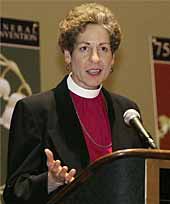
Of his her ass he she made a trumpet: Katharine Jefferts Schori

When asked during a CNN interview if homosexual activity is sinful:

"I don't believe so. I believe that God creates us with different gifts. Each one of us comes into this world with a different collection of things that challenge us and things that give us joy and allow us to bless the world around us. Some people come into this world with affections ordered toward other people of the same gender and some people come into this world with affections directed at people of the other gender."

Schori was recently elected presiding bishop of the Episcopal Church USA.

The Episcopal Church, awash in the "blessings" of sodomy and sundry heresies, has a membership roster shrinking swiftly enough to make it the fastest dying church in America. Perhaps that's the true blessing.

14 June 2006

Chronicle of the Damned, part nine (revisited)

We usually reserve this fate for groups and organizations. We think this a worthy exception to the rule.
Janice Sevre-Duszynska wants to be a Catholic priest. The 56-year old troublemaker, whose exploits include being arrested for trespassing at Ft. Benning (GA) and disrupting several ordination services demanding the bishops ordain her, prefers that her work be termed "prophetic obedience" rather than protesting. That's great. I would prefer that human excrement consist of gold bullion instead of feces; alas it isn't so.

"I used to make believe I was a priest, celebrating the Mass, blessing the people and giving the homily," Sevre-Duszynska says. "I knew the altar boy's prayers. I had learned them in Latin." As a kid I used to make believe I was playing drums in a band with Paul McCartney. Does that mean I should now make a public spectacle of myself because it didn't happen?

Idiocy is not her only crime. She also slouches towards blasphemy. "I am all of the oppressed women of the Bible. I am Sarah, I am Hannah, I am Elizabeth, I am the woman who touched the hem of Jesus' garment, I am the woman who anointed his head with oil." I won't even bother with a response here.

"To me, to be a priest means to live your life on the edge," she said. "To me, that's where the Holy Spirit is doing her dance." Again, enough said.

In July a dissident Catholic group will ordain Janice to the diaconate, and then, perhaps after further theological study (not that it will matter), to the priesthood. Interesting, but also irrelevant. Holy Orders in the Roman Catholic Church are not valid when an attempt is made to confer them upon women. Her "ordination" will exist only in her mind. Given its paucity, I'm sure that will be sufficient.

Recently Janice began a trek in Arizona with other activists through the Sonora desert. The goal was to walk 75 miles from Sasabe, Mexico, to Tucson. The desert is a hot place, Janice. You'd better get used to that.

In the world to come, Janice will serve in the diocese Lucifer gives to Roman Catholic Womenpriests. This diocese will occupy Circle Six, where heretics dwell. Under the guidance of Bishop Margaret Renewal, this group will also sink lower to occupy Circle Eight, where the purveyors of fraudulent rhetoric and the falsifiers roam. May the Lord, in His infinite mercy and kindness, take pity on those who are deceived by these miscreants.

13 June 2006

Christian Reflections, Twenty-one


"Ah, but my courage fails me, and my heart is sick within me! - Lord, take pity on the Christian who doubts, on the skeptic who would fain believe, on the galley slave of life who puts out to sea alone, in the darkness of night, beneath a firmament no longer illumined by the beacon fires of the ancient hope."
from A Rebours, by J.K. Huysmans


"Baudelaire, the satanic Baudelaire, who died a Christian, must surely be one of M. Huysmans' favourite authors, for one can feel his presence, like a glowing fire, behind the finest pages M. Huysmans has written. Well, one day, I defied Baudelaire to begin Les Fleurs du mal over again, or to go any farther in his blasphemies. I might as well offer the same challenge to the author of A Rebours. 'After Les Fleurs du mal,' I told Baudelaire, 'it only remains for you to choose between the muzzle of a pistol or the foot of the Cross.' Baudelaire chose the foot of the Cross. But will the author of A Rebours make the same choice."
- Jules Barbey d' Aurevilly


Quote for the Day


IX
"The troubles of our proud and angry dust
Are from eternity, and shall not fail.
Bear them we can, and if we can we must.
Shoulder the sky, my lad, and drink your ale."
- A.E. Housman
from Last Poems

12 June 2006

What Colleges Forget to Teach

City Journal
What Colleges Forget to Teach
Higher education could heal itself by teaching civics—not race, class, and gender.

Robert P. George
Winter 2006

The university is worth fighting for. No other institution can carry the burden of educating our young people. That’s why we must redouble our efforts to restore integrity, civility, and rigorous standards in American higher education—particularly in the area of civic education.

I’ll be the first to admit that the situation is dire. I sympathize when critics throw up their hands in despair. I sometimes feel that way myself. Darkness often prevails in places where the light of learning should shine. I often trade horror stories with my friend Hadley Arkes, a distinguished scholar of jurisprudence and political theory at Amherst. On one occasion, I explained that the Woodrow Wilson School of Public and International Affairs at Princeton was sponsoring a viciously anti-Catholic art exhibit—one that it would never even permit were some favored faith or cause, such as Islam or gay rights, its target. Every year, some outrage along these lines seems to prove that anti-Catholicism really is the anti-Semitism of the intellectuals, though anyone familiar with academic life today knows that anti-Semitism itself is making a run at being the anti-Semitism of the intellectuals.

Professor Arkes listened sympathetically and said, “Things have gotten pretty bad here at Amherst, too: we’ve granted tenure in political science to a guy promoting a theory explaining the foreign policy of George H. W. Bush by reference to his alleged homoerotic attraction to Ronald Reagan.” “Well,” I replied, “Princeton has topped that. We’ve given a distinguished chair in bioethics to a fellow who insists that eating animals is morally wrong, but that killing newborn human infants can be a perfectly moral choice.” (This professor has since gone on to say that there would be nothing wrong with a society in which large numbers of children were conceived, born, and then killed in infancy to obtain transplantable organs.)

And so we go back and forth with each other, in a macabre game of one-upmanship.

Still, teaching at Princeton is in many ways a joy. I have the privilege of instructing students who actually know when the Civil War took place. Even before arriving at Princeton, they know that Lee surrendered to Grant, not to Eisenhower, at Appomattox Court House. Most know that Philadelphia, not Washington, D.C., played host to the constitutional convention. Few would list Alexander Hamilton among the most important presidents, because they know that he was never president. Some can identify the cabinet office that he held and even give a decent account of his differences with Thomas Jefferson. Speaking of whom, all my students know that Jefferson owned slaves—but then, everybody seems to know that, even those who know nothing else about him. My students, though, also know that it was Franklin D. Roosevelt, not his cousin Teddy, or Harry Truman, or JFK, who promised Americans a New Deal. Some can even tell you that the Supreme Court invalidated some early New Deal legislation and that FDR responded with a plan to pack the Court. Yes, my students and students at elite universities around the country come to campus knowing American history pretty well—and wanting to know it a lot better.

Many of these young men and women value historical knowledge not merely for its own sake but because they want to be good citizens. More, they seek to be of genuine service to fellow citizens. Many hope to be legislators, judges, even president. They know that knowledge of American history is vital to effective citizenship and service.

But they also need an understanding of American civics—particularly the principles of the Constitution. For all their academic achievement, students at Princeton and Yale and Stanford and Harvard and other schools that attract America’s most talented young people rarely come to campus with a sound grasp of the philosophy of America’s constitutional government. How did the Founding Fathers seek, via the institutions that the Constitution created, to build and maintain a regime of ordered liberty? Even some of our best-informed students think something along these lines: the Framers set down a list of basic freedoms in a Bill of Rights, which an independent judiciary, protected from the vicissitudes of politics, would then enforce.

It’s the rare student indeed who enters the classroom already aware that the Framers believed that the true bulwark of liberty was limited government. Few students comprehend the crucial distinction between (on the one hand) the national government as one of delegated and enumerated powers, and (on the other) the states as governments of general jurisdiction, exercising police powers to protect public health, safety, and morals, and to advance the general welfare. If anything, they imagine that it’s the other way around. Thus they have no comprehension as to why leading supporters of the Constitution objected to a Bill of Rights, worried that it could compromise the delegated-powers doctrine and thus undermine the true liberty-securing principle of limited government.

Good students these days have heard of federalism, yet they have little appreciation of how it works or why the Founders thought it so vital. They’ve heard of the separation of powers and often can sketch how the system of checks and balances should work. But if one asks, for example, “Who checks the courts?” they cannot give a satisfactory answer.

The students’ lack of awareness flows partly from the conception of the American civic order that they have drunk in, which treats courts as if they aren’t really part of the government. Judges, on this view, are “non-political” actors whose job is to keep politicians in line with what elite circles regard as enlightened opinions. Judicial supremacy, of the kind that Jefferson and Lincoln stingingly condemned, thus winds up uncritically assumed to be sound constitutional law. The idea that the courts themselves could violate the Constitution by, for example, usurping authority that the Constitution vests in other branches of government, is off the radar screen.

Lacking basic knowledge of the American Founders’ political philosophy and of the principles that they enshrined in the Constitution, students often fall prey to the notion that ours is a “Living Constitution,” whose actual words matter little. On the Living Constitution theory, judges—especially Supreme Court justices—serve as members of a kind of standing constitutional convention whose role is to invalidate legislation that progressive circles regard as antiquated or retrograde, all in the name of adapting the Constitution to keep up with the times.
It doesn’t take much to expose the absurdity of this theory. The purpose of enshrining principles in a constitution is to ensure that the nation’s fundamental values remain honored even if they fall out of fashion. As for adapting the nation’s laws to keep up with the times, legislators can—and should—take care of that task. The proper role of courts when they exercise the power of judicial review is essentially a conserving (you could even say “conservative”) one. It is not to change anything but rather to place limits on what one can change.


Does this mean that our Constitution is “dead”? No: the Constitution’s principles are “living” in the sense that they can apply validly even to matters that the Founders themselves could not have anticipated. The original understanding of Fourth Amendment principles governing searches and seizures, for example, can reliably extend to cover today’s controversies about computer files, cyber-storage, and electronic surveillance. So to reject, as we should, the Living Constitution and its anticonstitutional doctrine of virtually unlimited judicial power is by no means to treat our Constitution as a dead letter. Rather, it is to treat the Constitution as law—supreme law—binding on, and limiting the power of, every branch of government and agency of the state, including the courts.

What is the source of this educational breakdown? The trouble isn’t the students—they’re bright and eager to learn. It’s that too few teachers are presenting students with the Founders’ philosophy, much less introducing them to the great issues, some still with us today, that divided the Founders.

And if teachers aren’t teaching the Founding’s principles, where will students learn them? They’re not likely to get any sense of the distinction between the delegated powers of the national government and the general jurisdiction of the states from any newspapers, national magazines, or television news networks, that’s for sure. Have the editors of the New York Times and the folks at CBS News even heard of that distinction yet? News travels slowly, true; but it shouldn’t take 218 years.

The solution to this educational breakdown is straightforward: we need to make a commitment at every level of schooling and within the public media to promote a deep awareness of the principles of the American Founding. Why educate students into archaism? some will doubtless object. Surely governing principles set forth in the eighteenth century have little relevance to us in the twenty-first. But American ideals, as embodied preeminently in the Declaration of Independence, are universal and timeless. They have force wherever there are human beings, fallible (indeed, as the Founders recognized, fallen) creatures, yet images of God in their possession of reason and freedom—beings, as the Declaration says, “endowed by their Creator with certain unalienable rights.”

The constitutional scheme that the Founders devised for the lawful governance of human beings and for the preservation of their sacred rights is the world’s greatest triumph of practical political science. Of course, we shouldn’t treat our institutions as if they’re perfect—the Founders provided, after all, for their possible revision by constitutional amendment. True civic education isn’t indoctrination. The Founders themselves weren’t of one mind as to the proper interpretation of their handiwork in every respect. And reasonable people of goodwill, of course, disagree about key matters of constitutional interpretation. We do our students a wonderful service when we invite them into the great historical and contemporary debates about the meaning of our fundamental law in controversial cases. To do that, though, we must equip them with the historical knowledge and the philosophical understanding necessary if they’re to evaluate intelligently the competing arguments.

We needn’t teach that our institutions are uniquely just—that any polity that seeks to respect people’s rights and preserve liberties must copy them precisely. But anyone who sincerely seeks the truth will see that ours are indeed worthy institutions that have served Americans well whenever our people and leaders have shown the wisdom and mustered the fortitude to honor and live by them. The fact is, freedom-loving people throughout the world—even in an age darkened by widespread anti-Americanism—draw inspiration from American ideals and look to American institutions as the gold standard of republican government. Even critics of American policy feel that they must pay lip service to our ideals of democracy, limited government, equality before the law, civil liberty, private property, the free economy, and the rule of law.

Madison did not doubt that it would be so: “The free system of government we have established,” he wrote, “is so congenial with reason, with common sense, and with a universal feeling that it must produce approbation and a desire of imitation, as avenues may be found for truth to the knowledge of nations.” In Eastern Europe, much of Latin America, and parts of South Asia, Africa, and the Middle East, “avenues have been found for truth to the knowledge of nations.” Yet, at the same time, in the U.S. itself, public comprehension of “the free system of government” that Madison and his “founding brothers” bequeathed to us has eroded. We must reverse that trend. Otherwise, the quality of citizenship and statesmanship will inevitably suffer.

Madison famously observed that “only a well-educated people can be permanently a free people.” Yet some today seem to think otherwise. They don’t necessarily doubt that the impoverishment of civic understanding erodes citizenship and statesmanship, but they wonder why we can’t get along perfectly well anyway. We are, after all, the richest, most powerful nation in world history. We’re on top, and despite emerging economic challenges from China, maybe India, we’re likely to stay there. Isn’t that enough?

To this, a double reply. First, history shows us that basic freedoms are hard-won and easily lost. The institutions that preserve freedom can be crumbling even as they appear strong. Severe economic strains and other fundamental challenges can tempt people to compromise or sacrifice even basic freedoms. As Madison knew, it is conviction born of knowledge—civic understanding—that is our bulwark, our only true security, in the face of such temptations.

Second, as Plato (though no admirer of democracy) observes, the goal of the polis—the political order—isn’t merely to establish security but also to provide the conditions for citizens to live good and decent lives, worthy of human beings as rational and moral creatures. Our founders saw this crucial philosophical point. The purpose of the Declaration of Independence and its principles of civic life, Jefferson wrote shortly before he died, were “not to find out new principles or new arguments never before thought of, nor merely to say things which had never been said before, but to place before mankind the common sense of the subject. . . . All its authority rests on the harmonizing sentiments of the day, whether expressed in conversation, in letters, printed essays, or in the elementary books of public right, as Aristotle, Cicero, Locke, Sydney, etc.”

These “elementary books” inform us that statesmanship and, especially, citizenship, though key means to other ends, possess a value greater than merely instrumental. When we carry out our civic responsibilities in an informed way, we find ourselves ennobled as individuals and as a community. Even if a nation could remain on top in the global competition for military and economic superiority, and even if its basic political structure could last more or less indefinitely, the people of that nation, if they remain ignorant of the moral foundations of that structure, would be impoverished.

Whatever one thinks of the decision to invade Iraq, one cannot fail to find deeply moving the desire of the vast majority of Iraqis to be democratic citizens—a desire that cannot be accounted for merely by noting the tendency of democracies over time to be prosperous and stable. Rather, Iraqis proudly displaying ink-stained fingers are saying something that we Americans, at some level, still appreciate: that democratic citizenship fulfills an important aspect of our humanity. It is so inherently desirable that Iraqi men and women have risked their lives to exercise the franchise, just as it caused those eighteenth-century Americans who pledged their “lives, fortunes, and sacred honor” to risk the king’s hangman’s noose.

Our posture cannot be—must not be—complacent. We must firmly resolve to make reform and renewal—whatever the obstacles, whatever the costs—our constant endeavor. We must not let the resistance of entrenched interests or recalcitrant ideological forces in the academic establishment, the funding bureaucracies, or anywhere else intimidate us. Let us seize every opportunity, marshaling our resources and deploying our wits to advance the cause of reform wherever we detect an opening, however much the weeds may obscure it. The reform and renewal of civic education in our nation is a noble cause. We must make it an urgent priority.

Christian Reflections, Twenty


Come Thou Fount of Every Blessing
by Robert Robinson, 1758

Come, Thou Fount of every blessing,
Tune my heart to sing Thy grace;
Streams of mercy, never ceasing,
Call for songs of loudest praise.
Teach me some melodious sonnet,
Sung by flaming tongues above.
Praise the mount! I’m fixed upon it,
Mount of Thy redeeming love.

Here I raise my Ebenezer;
Here by Thy great help I’ve come;
And I hope, by Thy good pleasure,
Safely to arrive at home.
Jesus sought me when a stranger,
Wandering from the fold of God;
He, to rescue me from danger,
Interposed His precious blood.

O to grace how great a debtor
Daily I’m constrained to be!
Let Thy goodness, like a fetter,
Bind my wandering heart to Thee.
Prone to wander, Lord, I feel it,
Prone to leave the God I love;
Here’s my heart, O take and seal it,
Seal it for Thy courts above.

O that day when freed from sinning,
I shall see Thy lovely face;
Clothed then in blood washed linen
How I’ll sing Thy sovereign grace;
Come, my Lord, no longer tarry,
Take my ransomed soul away;
Send thine angels now to carry
Me to realms of endless day.